- support@dalhangyanmancs.res.in


Cercospora leaf spot (CLS)
Cercospora leaf spot (CLS)
Cercospora leaf spot is a major disease that causes heavy loss to Urbean crop. The disease appears in all the urdbean growing regions of India. High atmospheric moisture conditions favour the spread of disease. The disease is caused by Cercospora cruenta or Cerocospora kenesens fungi. The disease is seed borne therefore seed treatment should be followed before sowing to prevent this disease. The fungus remains in the soil and crop residues. The possibilities of infestation in next year are high if Urdbean crop is cultivated in these fields.
Symptoms:
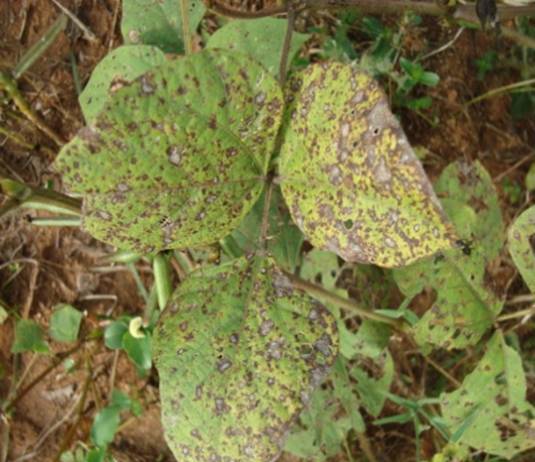
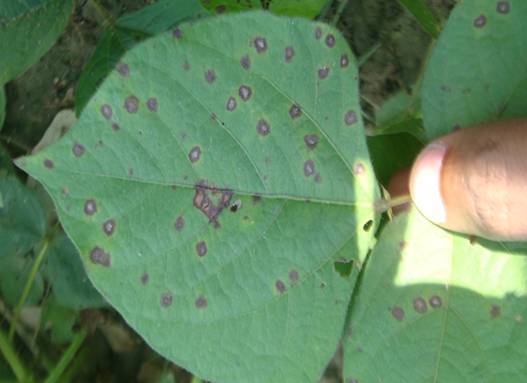
- The disease symptoms is typically characterized by dark brown spots on the leaves, surrounded by red outer edges. These spots may be (5-7 mm diameter) with ash coloured central part and purplish red borders or they may be small (1-3 mm diameter), rounded with yellowish brown center part and reddish brown borders.
- The spots are clearly visible at the upper surface.
- Under favourable climatic conditions, the spots coalesce to form bigger spots and the diseased leaves drop down. The infection usually starts form the older leaves.
- Under severe infestation, the spots may be observed on branches and pods also. Seeds of these pods also become shrinked and discolor.
Management
- Use of disease free seed help in reducing the seed borne inoculums of the pathogen.
- Field sanitation, crop rotation, destruction of infected crop debris and avoiding collateral hosts in vicinity of the crop may help in reducing disease incidence.
- Delayed sowing of mungbean in Kharif reduces the disease severity and helps the crop to escape from heavy rains.
- Treat the seed with the fungicides captan or thiram (@2.5 g/kg) before sowing.
- On onset of symptoms on leaves, spray carbendazim (0.05%) @ 0.5 g/l or mencozeb (0.25%) @ 2.5 g/l on crop. The spray may be repeated 2-3 times at 10-15 days interval, if required.
- If the disease appears after the pod setting, spray of fungicides may be avoided as, at this stage the disease does not affect yield much.