- support@dalhangyanmancs.res.in


Anthracnose Disease
Anthracanose Disease
This disease is caused by Colletotrichum lindemuthianum. The disease causes qualitative as well as quantitative losses. The yield losses due to disease have been estimated to be 24 to 67 per cent. Cloudy weather with high humidity and temperature between 26-30 oC favours the disease occurance. Infected seeds and debris of infected crops are the initial source of disease in crops.
Symptoms:
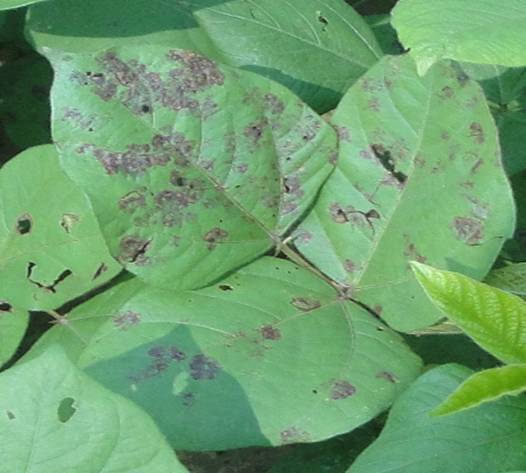
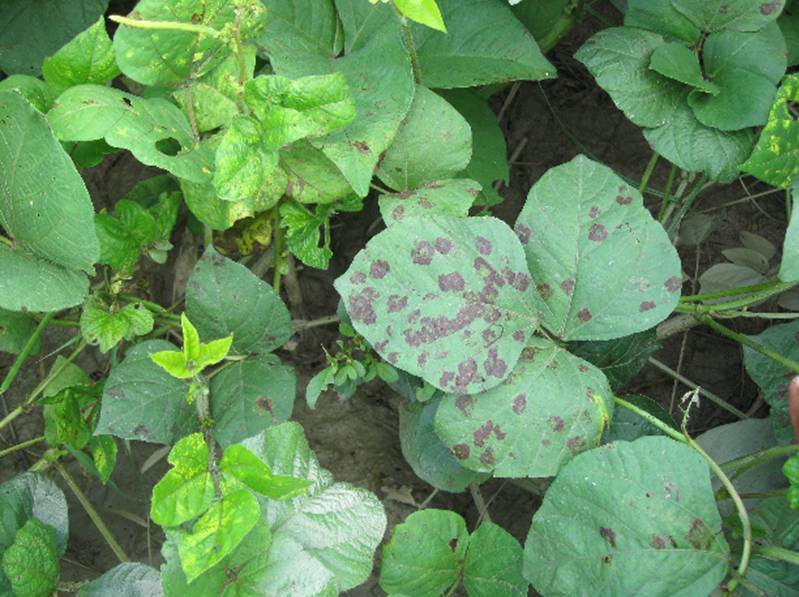
- The disease is characterized by serious leaf spotting ultimately resulting in “shot hole” symptoms and finally defoliation. In favorable conditions, the spots turn to red colour while the edges become shiny bright red . As the intensity of the disease increase the infested parts (spots) fell down leaving a hole.
- Pod infection directly damages the seeds and reduces its germination.
- Brown, sunken lesions formed on the cotyledons and the young stems of seedlings.
- During wet conditions, the lesions increase in size and number and young plants are killed.
- On pods, depressed, black cankers appear, sometimes with flesh coloured centres.
- Seeds may also be infected resulting in pre-emergence death.
- In severe infections, the affected parts may wither off.
- Sometimes the spots may be sickle shaped, circular to irregular in shape with grey centres and measure 4 to 8 mm in mungbean.
Management
- Use certified seeds that treated with fungicides.
- Treat the seeds with thiram or captan @ 2-3 g/kg seeds before sowing.
- When the symptoms start to appear, apply the foliar spray with Zineb or thiram @0.2% at 15 days interval. Foliar spray of carbendazim or mancozeb @0.2% is also found to be effective.